



18 Feb #RSUDC21 Day Nine: Health and Wellbeing
Written by: Jessica Buckle and Tabitha Binding
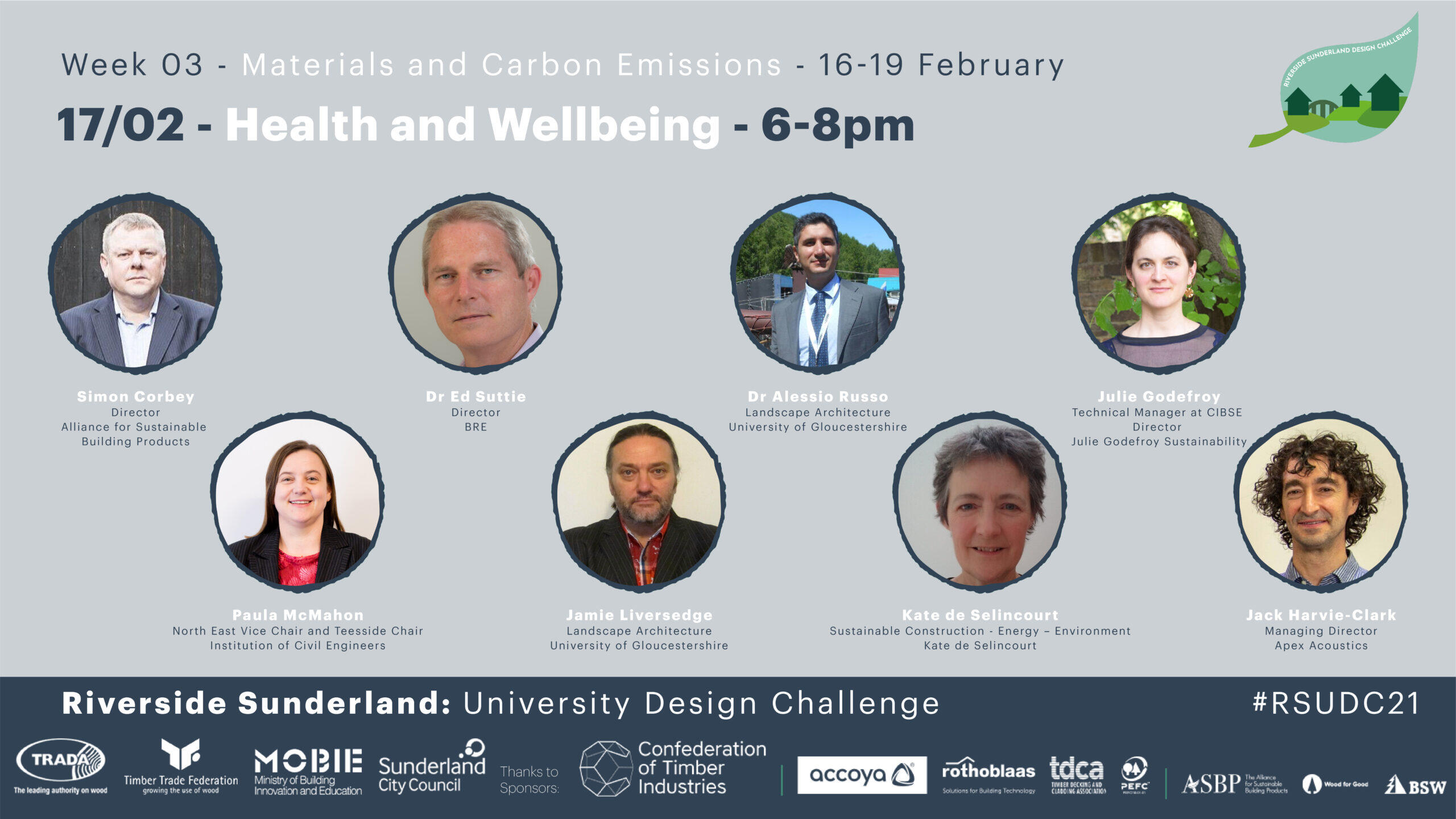
What makes a healthy home, community and environment? Tonight’s experts highlighted the beneficial properties of timber in the home for #RSUDC21.
Natural materials and planting can affect not only our sense of community and well-being but also the indoors and outdoor the air quality. Health benefits can include thermal and visual comfort and sound attenuation.
Week three of the Riverside Sunderland: University Design Challenge (#RSUDC21) and interactive webinar series continued with the theme ‘Health and wellbeing’ last night. The session was introduced by Tabitha Binding and chaired by Director at the Alliance for Sustainable Building Products (ASBP), Simon Corbey.
ASBP is a cross-sector, non-profit organisation which brings together building product manufacturers and distributors, specifiers, designers, contractors, public interest and sustainability organisations, academics, as well as building practitioners. They are focused on promoting a high performance, healthy and low-carbon built environment by increasing the understanding and use of building products that meet demonstrably high standards of sustainability. This includes events taking place next week, including an Innovation Pitch Series, Healthy Buildings Conference and the 2021 Awards Final.
The presentations commenced with North East Vice Chair and Teesside Chair of the Institution of Civil Engineers (ICE), Paula McMahon, discussing the built environment and local context. Sustainability and carbon neutrality has become paramount within everything we do. McMahon reiterates the importance of interdisciplinary collaboration within a design team and how this approach benefits design, build and value (environmental and health and wellbeing based, as well as monetary).
To help support this collaboration, ICE have been working on Engineering Together to help built environment professionals navigate through STEM and engineering organisations and democratise resources. Such strategic changes are needed to accelerate change. This includes working together affect building regulations which support a sustainable future.
The baton was then passed to the Director of BRE, Dr Ed Suttie, to describe the benefits of using timber within the home for health and wellbeing, applauding the competition and the initiative. Buildings have a clear effect on health, and poor design can exacerbate Seasonal Affective Disorder (SAD), depression and respiratory conditions.
Biophilic design is an innovative method of which can increase occupant connectivity to the natural environment through the use of direct nature, indirect nature, and space and place conditions. The biophilic hypothesis suggests that humans possess an innate tendency to seek connections with nature and other forms of life. Key contracts of biophilic design include contact with nature, natural analogues and human spatial response.
Research highlights that wood has a positive impact on human psychology and physiology, especially within building types such as hospitals, workplaces and educational spaces due to its versatile, natural and beautiful characteristics.
Next up was Landscape Architect and Senior Lecturer of Landscape Architecture at the University of Gloucestershire, Jamie Liversedge, discussing the benefits which natural materials bring to the built environment. Liversedge encouraged sharing ideas, nurturing concepts, and exploring technological challenges to understand what natural materials are and how they contribute to achieving an ethical approach to the planet.
These ethical conversations should also happen between clients and the design team, with master plans a key touch point. Masterplans provide a framework for development, a guide to the site and concept, as well as parameters within which designers operate. They operate on two levels; functionally resolving a brief on a range of scales and developing an aesthetic approach to the brief. Master planning as a landscape-led process pedestals the landscape as the key driver of the master planning process, exploring aspect and orientation, green infrastructure networks, spatial hierarchy and sequence, health and wellbeing and connectivity. Decisions are based upon aesthetic processes and science.
Senior Lecturer and Academic Course Leader in MA Landscape Architecture at University of Gloucestershire, Alessio Russo followed elaborating on how landscaping can positively influence external air quality. Designing a green infrastructure through Nature-based Solutions (NBS) use ecosystems and the services they provide to address societal challenges such as climate change, human health, food or water security, economical and social development, as well as natural disasters. Sustainable communities are unequivocally connected with ecosystem services and wellbeing. Integrating nature and vegetation barriers into cityscapes presents invaluable benefits. Russo concluded providing useful design tool suggestions for example iTree and ENVI-met.
Writer and Editor specialising within sustainable construction, energy and environment, Kate de Selincourt continued the conversation on air quality.
Selincourt highlighted health concerns as a result of long term exposure to air pollution, such as affects upon respiratory systems, the heart and circulation and mental health. Key aspects in achieving a healthy internal air quality (IAQ) include source control, airtightness, ventilation and warmth. Utilising modern methods such as the Passivhaus approach and the MVHR system would be a huge step forward.
Technical Manager at CIBSE and Director at Julie Godefroy Sustainability Ltd, Julie Godefroy expanded this topic, discussing visual and thermal comfort, creating an equilibrium between daylight and artificial light, as well as under and overheating. Concepts of which are both much overlooked within the design process.
Godefroy explains the challenge of connecting elevations and fabric performance, layout and ventilation strategy. Naively associating fabric performance solely with improving energy performance can reductive, as it also affects noise exposure and temperature. Adoption of the Passivhaus comfort standard and methodology is a highly effective method of providing high standards of occupant comfort and health, as well as reducing energy use and carbon emissions from buildings in the UK. Overheating must be considered alongside energy performance. Godefroy uses thermal imaging as a diagnostic tool to visually explain the impact considering this would have, as well as highlighting the benefit of reaching beyond the building regulation Part F provision.
Concluding the evening with an interactive analysis of acoustics was Managing Director at Apex Acoustics, Jack Harvie Clark. Apex Acoustics undertake design and testing in all areas of noise and vibration and provide practical, cost-effective and timely solutions to meet requirements, contributing standards within regulation guidance.
Harvie Clark examined what is sound, why sounds are important and how using acoustic information would result in a more suitable built environment. Sound massively affects the ambience of a space and consequently the experience. Sound is deeply wired within our brains and is significantly used as a communication method. However excessive noise proves detrimental to our health and sleep patterns. A study completed by the World Health Organisation in 2011 highlights that more than one million healthy life years are lost across the European region due to the impact of noise. Guidelines and research is being undertaken to solve the impact of noise barriers and provide recommendations. Analysing noise maps in relation to the Riverside Sunderland site context is endorsed.
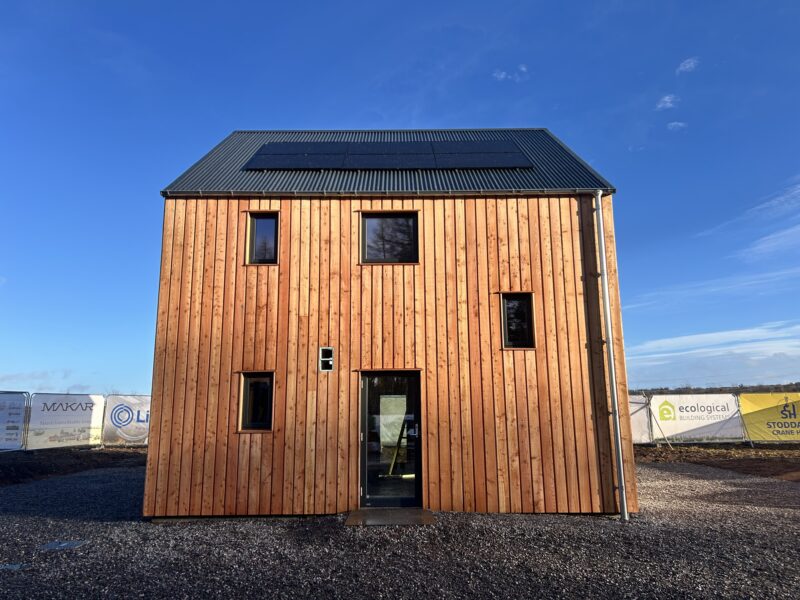
Photo credit: Steico, via Timber Trade Federation.
With special thanks to our Gold Sponsor, Confederation of Timber Industries, our Silver Sponsors Rothoblaas, Accoya, PEFC UK and TDCA, our Bronze Sponsors ASBP, BSW and Wood for Good.
All submission and registration information is available on the TRADA, TTF and MOBIE websites, or within the brief which will be distributed to those registered. Registration remains open until 26 February 2021. There will be Q&A opportunities at the end of each webinar.
This evening, week three of the #RSUDC21 webinar series continues with ‘Timber Challenges’, Timber is by far the best low carbon, sustainable, renewable construction material that we can use to build with, but it needs to be specified and detailed correctly. Find out how to detail for fire and moisture in construction and use tonight at 6pm. Book by 4.30pm today via Eventbrite. Thursday 18 Feb 6pm – Timber Challenges.
Our ‘Open House’ informal networking and discussion event is on Friday which brings together like-minded leaders from the construction industry, educators, students and professionals, climate change pioneers.
Students can register their interest for the competition and find further information on the partners and sponsors websites at TRADA, CTI, or MOBIE.