


02 Feb #RSUDC21 Day One: Launch of the Riverside Sunderland University Design Challenge and webinar series
Written by: Jessica Buckle and Tabitha Binding
The Riverside Sunderland: University Design Challenge (#RSUDC21) and interactive webinar series were launched last night in an event which brought together leaders from the construction industry, educators and professionals, and the leadership of Sunderland City Council, with more than 120 students from 25+ universities across the UK.
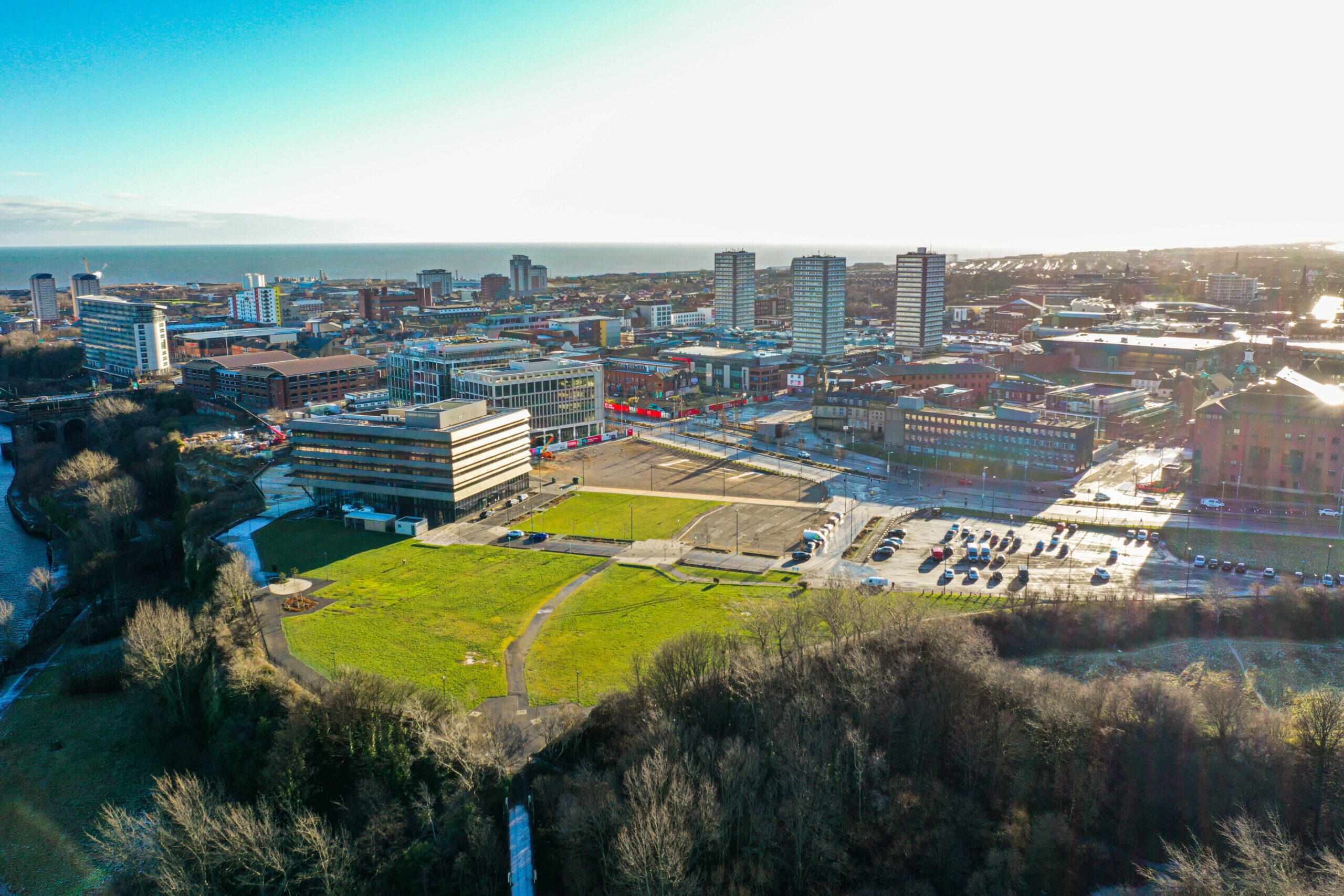
Opening the series, Chief Executive of Sunderland City Council, Patrick Melia introduced Riverside Sunderland’s regeneration project, a ‘unique place for people to live, work and play’ which is underway, and set to include elements such as a new business district, a city library and creative hub, riverside park, green boulevard and two bridges specified for pedestrians and cyclists. This is the backdrop upon which students will project their designs in RSUDC21.
The Riverside Sunderland project will implement sustainable design methods, which promote movement, connectivity and independence while maximising energy efficiency, addressing fuel poverty, and implementing a smart city infrastructure. The design competition offers student participants the chance to act as future innovators within the UK built environment, challenging, and encouraging innovative and progressive design outlook, both now and with continued improvement on into the future.
Founding Director and Chief Executive at CAST, as well as Government MMC Champion, Mark Farmer talked on the need to overcome the productivity problem within the UK construction industry. Failure is not an option, with a lack of high quality, sustainable housing being highlighted during the Covid-19 global pandemic. Many in the UK are rightly demanding improved outcomes and for fundamental change in the way we build – which must be better quality, quicker and more sustainable.
These goals are achievable through innovative design, which is why #RSUDC21 promotes practical application, technical challenges, home design and master plan, design and manufacturing process, sustainability and carbon debate, as well as combining inter-disciplinary professional skills, simulating the real professional sphere.
Sunderland City Council Development Director, Neil Guthrie, revealed details of the competition site location, being within the heart and periphery of Sunderland city centre. Guthrie reiterated that community is key, and that the residential development programme enables inhabitants to take control of land and outputs; influencing, intervening and making change. The brief requires teams to develop an indicative master plan, landscape and streetscape housing 100 innovative carbon neutral new homes, on a dramatic peninsular overlooking the River Wear. The design must be adaptable to meet the living and working needs of present and future inhabitants.
The design project encourages students to reach, or even to go above and beyond the RIBA 2030 challenge. This means putting yourself in the shoes of inhabitants to implement transformational change, and consider the future.
Timber Trade Federation (TTF) Chief Executive, David Hopkins, talked on the versatility and potential of timber within the low carbon sphere – stating that competitions like this are vitally important for creating change within the built landscape and can dramatically affect how designers perceive projects, buildings and place. As a replenishable, versatile and sustainable building material, timber is key to reducing the carbon emissions of construction.
British Woodworking Federation (BWT) Chief Executive, Helen Hewitt, highlighted the vast potential of timbers performance as a functional, sustainable and aesthetically pleasing building material, giving longevity, security, value for money, and also maintenance potential. BWF has many accessible and valuable online resources such as ‘choose wood’ and the ‘Wow I Made That Programme’ designed for students.
Structural Timber Association (STA) Chief Executive, Andrew Carpenter, accentuated Mark Farmer’s quality over quantity statement, especially following the Grenfell Tower tragedy in 2017, which launched a huge enquiry into cladding systems. STA is committed to helping drive quality in the industry, with timber technical guidance, essential standards guides and a variety of timber frame structures all free to students who sign up as members of the STA. Carpenter finishes with ‘you are the future and the STA want to work with people who want to change the world’.
Chief Executive of MOBIE and Environmental Planner, Mark Southgate talked on the competition as a fantastic opportunity, with a great site location; working with people, nature and surrounding buildings, through the lens of his experience with MOBIE, which was created by George Clarke (George Clarke’s Amazing Spaces) to create a generational shift in homebuilding.
Chair of Construction Industry Council (CIC) North East and Director of CK21 Ltd., John Neilson recalls introducing a ‘One Voice’ North East construction strategy, and how this strategy aligns with the Design Challenge, with both aiming to create a ‘one voice’ aspect of coordination, cooperation and collaboration within an entire design team, representing all built environment institutions working together. Unfortunately, an unusual sight within academia, however essential within a professional working environment. Perhaps this challenge will lead as an example for final year University schemes, encouraging students to learn from the colleagues and construction becomes a collaborative team project.
TRADA Director and Associate at Whitby Wood, structural engineer Kelly Harrison introduced the Timber Research and Development Association (TRADA), and University Engagement Programme, partners in the design competition, who are helping to inform better practice and independent authoritative information on timber. This lead directly onto the TRADA and TTF Programme Manager, Tabitha Binding, who has been instrumental in igniting the competition and webinar series, who finished with an enthusiastic whistle-stop tour, demonstrating TRADA’s extensive Academic Resources including a wood species database and detailed case study examples. Highlighting the endless design opportunities timber can present, when combining the vast knowledge of professionals within the built environment and used wisely. Right product, right place and a bright future.
With special thanks to our Gold Sponsor, Confederation of Timber Industries, our Silver Sponsors Rothoblaas, Accoya, PEFC UK and TDCA, our Bronze Sponsors ASBP, BSW and Wood for Good.
The launch was concluded with an informal and brief Q&A. All submission and registration information is available on the TRADA website or within the brief which will be distributed to those registered. Registration remains open until 26 February 2021. There will be Q&A opportunities at the end of each webinar.
This evening the TRADA webinar series commences with ‘The Climate Challenge’ focusing on themes of Net Zero and Carbon Neutral Homes, RIBA 2030 Climate Challenge, LETI route maps, operational and embodied carbon basics. You can register via EventBrite.
Students can register their interest ffor the competition and find further information on the partners and sponsors websites at TRADA, CTI, or MOBIE.