



Our carbon-intensive economy and the emissions it produces is the cause of climate change, but also supports our modern standards of living. By moving towards a low carbon economy, we can both save the planet and support the livelihoods of people, here in the UK and abroad. Timber is an essential product within the low carbon economy.
What is the low carbon economy
The low carbon economy is built upon production centred on low energy use, low emissions, and the use of carbon capture and storage (CCS) technologies. While the first two ensure the overall emission of greenhouse gases, such as carbon dioxide, are kept to a minimum, CCS allows any necessary carbon emissions to be reabsorbed.
This economic model is designed to achieve ‘Net Zero’ carbon emissions, which refers to overall either neutral or negative carbon emissions. The UK has made multiple pledges to shift to a low carbon economy, and was the first major economy to legislatively commit to Net Zero carbon emissions by 2050 through an amendment to the Climate Change Act 2008 which was passed in 2019.¹ Since then many more countries have committed to Net Zero Carbon, including Austria, Bhutan, Costa Rica, Denmark, Fiji, Finland, France, Hungary, Iceland, Japan, the Marshall Islands, New Zealand, Norway, Portugal, Singapore, Slovenia, Sweden, Switzerland, and the European Union.²
How does timber fit into this economic model
Timber is a part of the bio-economy, which focuses on the use of renewable, biological-based resources. These require less energy and result in fewer emissions in production, use and disposal than their man-made counterparts, while also being recoverable, recyclable and reusable. It is widely recognised the greatest levels of GHG abatement from biomass within this economy currently occur when wood is used as a construction material in buildings to both store carbon and displace highcarbon cement, brick and steel.3
The growth of the timber market, both in the UK and globally has allowed for, from 2000 and 2015, the total area certified under sustainable forestry management (SFM) to increase from 12% of total forest area to 54%.4 Continuing to expand the amount of forest area under SFM is essential for protecting biodiversity, helping prevent climate change, and preserving the livelihoods of 1.6bn people. If all timber and pulp and paper products for the top 100 pulp and paper companies alone came from SFM-certified forests by 2030, the business opportunity could amount to $165 billion.5 This prospect includes relatively nascent products such as high-value low-volume timber, as well as new end-applications such as timber buildings, which alone could be worth $45 billion per year by 2030.
The advantage of building with timber
Wood has an excellent carbon performance relative to the key construction and manufacturing materials it can substitute. It is calculated that producing a tonne each of steel and aluminium generates 1.24 tonnes and 9.3 tonnes of CO2 respectively. By contrast, wood absorbs CO2 from the atmosphere, at an average of 0.9 tonnes of CO2 per cubic metre of wood used in construction. You can read more about this in our article, Building with biomass, as well as in ‘Wood: Building the bioeconomy‘.
Timber also offers the chance, by virtue of its amenability to Modern Methods of Construction, to help solve the housing crisis in the UK. Currently, the industry is not balancing supply with demand. However, through offsite construction methods using timber, such as timber frame and CLT, there is potential for up to 30% quicker build times, more than 90% reduction in waste, as well as long term cost savings. These are detailed in the APPG report, ‘How the timber industries can help solve the housing crisis’.
Opportunities for the UK within the low carbon economy
With the world’s population growing by 83 million a year, there will be an extra one billion people on the planet by 2030. The World Green Building Council in their report, Bringing Embodied Carbon Upfront, highlights that by 2060, the total global floor area of buildings will double, with more than 50% of this anticipated within the next 20 years.6
The growth in new buildings will be particularly rapid in Asia and Africa, while Europe faces a different challenge – that of an ageing existing building stock and the expectation that up to 80% of buildings in use in 2050 already exist today. Currently about 35% of buildings in the EU are 50 years old or older, and 97% of the building stock is not efficient enough to comply with future carbon reduction targets. These buildings will require deep, energy efficient renovation, contributing to increased embodied carbon even as operational emissions are reduced.
By making the right investments into low carbon construction, regulatory alignment, and education for those coming into the construction industry, the UK could become a leader in the provision of low carbon construction expertise, both in the retrofit and new build sectors in this growing international market. Published in 2015, the Global Construction 2030 forecasts the volume of construction output will grow by 85% to $15.5 trillion worldwide by 2030.7
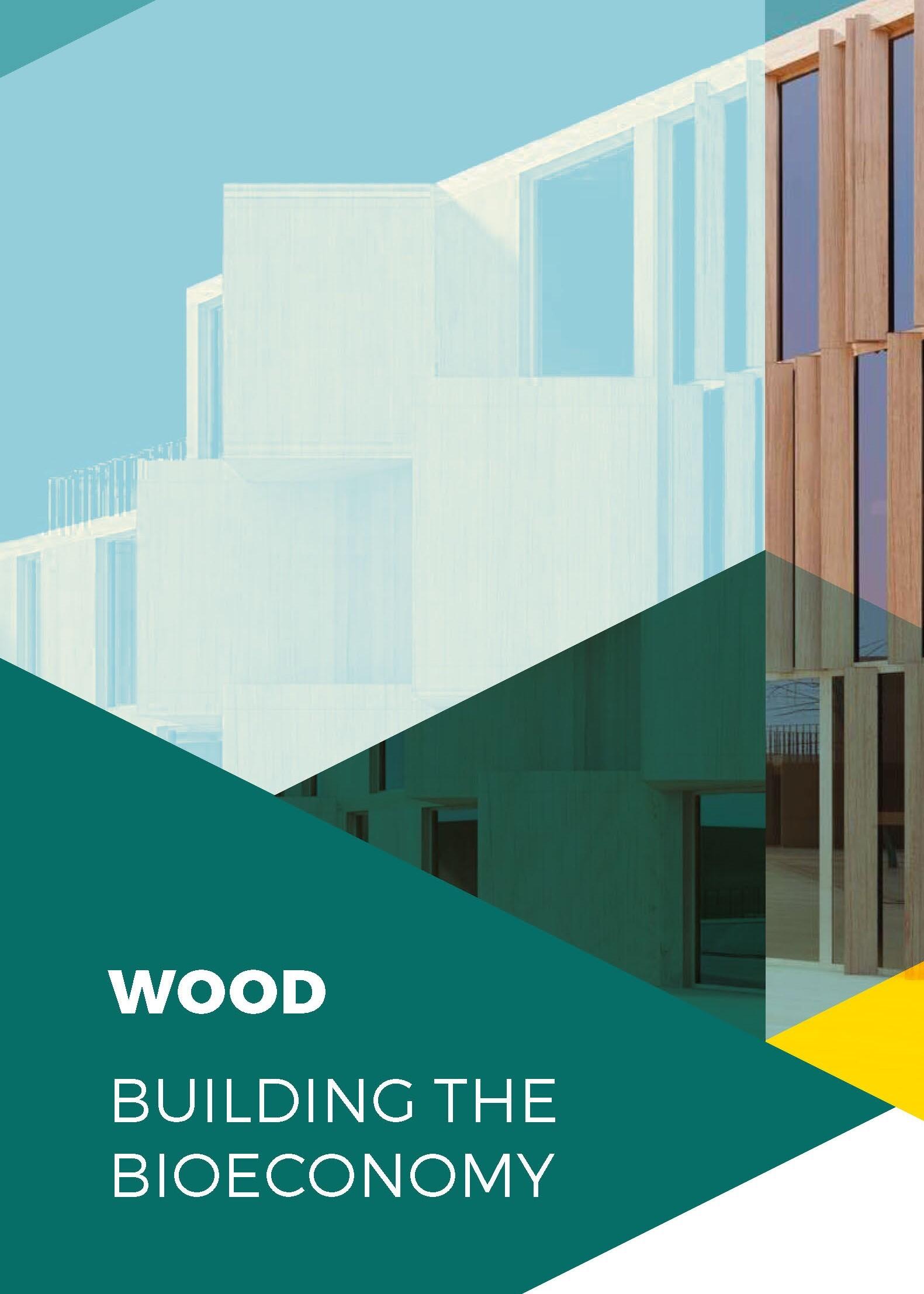
It is increasingly realised that a core component of a circular bioeconomy must be greater use of wood products from sustainably managed forests. Wood performs well in life cycle analysis, which measures a material’s carbon and other environmental impacts from cradle to grave (see Chapter 5). It is being developed into increasingly advanced engineered construction and manufacturing products and systems, with cellulose fibre also used as the basis of an increasingly diverse range of fabrics, bioplastics and other advanced materials. Ultimately, after its range of uses, it is also capable of ‘energy recovery’ through incineration, providing a renewable, carbon-neutral source of heat and power.
In short, a growing body of opinion maintains that we shouldnow be moving into a new industrial and developmental era. We’ve been through stone, bronze and iron ages. More recently we’ve had the concrete, steel, glass and plastic age. Now is time for the wood age.
Sources
¹ UK Government, ‘The Climate Change Act 2008 (2050 Target Amendment) Order 2019’. Last accessed 24 August 2020.
² World Resource Institute, ‘What does Net Zero emission mean’. Last accessed 24 August 2020.
³ UK Committee on Climate Change, ‘Biomass in a low carbon economy’. November 2018.
4 Science Magazine, 141 Barbier, E. B. et al., “How to Pay for Saving Biodiversity”, 4 May 2018.
5 World Economic Forum, ‘The Future of Nature and Business‘, 15 July 2020
6 World Green Building Council, ‘Bringing Embodied Carbon Upfront‘, 23 September 2019
7 Oxford Economics, et al, ‘Global Construction 2030′, 10 September 2015.